

Jem and I are both on holidays. This is a pretty weird concept, as for years we were both freelancers who didn’t have officially designated holidays. Lately when we have taken leave, we have done so because were travelling abroad. This year, however, with the global economic crisis and home renovations and all, we are on holidays at home in Latvia. It has been wonderful. We have been at Kūgures and not done much. The last few days Jem has been building a bookshelf from recycled timber, while I have been meditating on preserving cucumbers. As you do.
This summer was stingy in the berry department, so I haven’t made much jam, but the heat must have for perfect conditions in greenhouses, because there is a flood of local cucumbers. I woke up two mornings ago to find a huge shopping bag crammed with cucumbers on our doorstep, left there by our neighbours who just don’t know what to do with their over-abundant crop. So I looked up pickling cucumber recipes and talked to a few preserving-guru friends, who recommended making “Latgales” salad - marinated cucumber slices with onion. So that’s what I’ve been doing. Slicing cucumbers and heating jars. And crossing my fingers, because I am taking a wild stab in the dark regarding pasteurizing the jars after they’ve been filled with the cucumber mixture – I guess they could be fermented, exploding messes in a week or so. We’ll see.
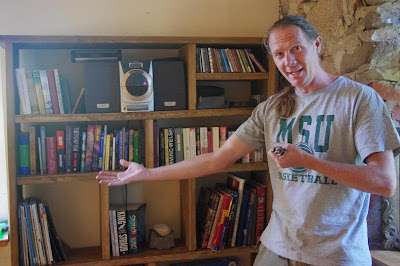
Jem’s project has been a success , and after many many hours measuring and cutting and sanding and drilling and measuring again and drilling some more and, dare I say, “finessing”, a handsome bookcase now adorns the corner of Kūgures living room. What will be his next furniture building project, I wonder?
Another thing we have done while on leave is go to a two day music festival. Of course these happened to be two stinking hot (yes – over 30 degrees, which is crazy hot in LV) days, whereby sitting in the sun listening to concerts and sleeping in an airless tent were a trial at times – but generally a good time was had by all. Music festivals are only just now beginning to take off in Latvia. You don’t get crowds as big as in Australia or other “western” countries, but it is a pleasure to see that younger Latvian music organizers are starting to give it a go. This festival mainly featured local bands and performers, but it had four stages going, the requisite activities for kids, weirdo art installations, dj booth, recycled clothing stalls and overpriced food vans.
I’ve got to admit I’ve always loved the music festival atmosphere and it was a pleasant surprise to see that the kids enjoyed it as much as we did. The night before Tiss and Mikus had put on a big whinge about not wanting to go, because they didn’t want to go to lots of concerts. But on the first night, when we stopped at 1am to have a snack before retiring to bed, I could see that my two overtired sons were hooked on the excitement of so much music and mayhem going on around them all at once. We had already seen fire twirlers, a friend’s bands play, a hard rock band in a big cleared-out hay barn, run into a crowd of crazy dancers at the front of a stage and danced madly along with them, played a bowling game and won prizes, been accosted by the evangelistic vegetarian crowd, posed for photos on a piece of interactive art, and pitched our tents in a huge apple orchard next to 100s of other tents. Of course, there were low points, for example when the DJ booth finally finished blaring over the camping area at 6am and Mikus woke up after only a couple of hours sleep - this was definitely not fun - but generally, we had a great time, and I am sure that the next time we suggest going to a music festival our sons will be hyped and excited at the prospect of what is to come!




Last week our extended family from LV, the USA and AUS got together to celebrate a milestone - my grandmother's 100th birthday. It was quite surreal for us all to be united at our family property, Kugures - here's a family pic from the 1930s, taken in the same place as the photo from last week. What leaves an impression looking at both photos, is the many and varied lifestories that are attached to each of the people in the pictures - behind each one of those faces is a completely original story. These tales intersect at some points, but these events, although they may be shared, are viewed through the prism of each individual, thus making each one an inimitable story of one's own. One common thread for all - Kugures - which has stood in this place for over 200 years.
 In the 1930s there was a campaign in Latvia for locals to be tourists in Latvia itself: "Apceļo Dzimto Zemi!". I have always thought that this was obviously the way to go - to know your own country as well as travelling around others - but until now, for one reason or another, we had not done very much travelling in Latvia itself. This year, mostly because the kids are bigger and no longer scream during long car trips (thanks for the Ninteno DS, Oma and Opa!), and partly because we are not travelling anywhere overseas this summer, it is the Summer of Local Tourism. I had also decided to begin to actively take people up on vague offers of visiting them at their country houses (people tend to put out "you must come and stay with us in the country this summer" invitations quite often), and so when the parents of Tiss' school friend invited us out, I purposefully set a date and this weekend, we packed up the car and headed out to their place in Latgale.
After an almost 5 hour trip (which was meant to take 3 hours but lengthened because Mikus began to vomit and wouldn't stop - and this was even BEFORE he started playing the DS), we turned up at their place, way in the middle of a wheat field, right by a slow-flowing river. The river was perfect for swimming, not very deep, with a sandy bottom, and the boys spent the next day in the water. This country property also had a melna pirts - or a black sauna - which we went in that evening. I won't go into the cultural description of saunas in Latvia - that is a post that has been brewing for a while - but in short, a black sauna is a traditional sauna which has no chimney, which means that the smoke from the fire fills the room and is let out before you go into the sauna to wash. The walls of the sauna and the stones on the stove are black with soot. This was our first time in a black sauna and it was very pleasant - the heat felt a bit different, kind of softer, I guess, and visually, people look so good against the black walls! We spent most of the two outside, eating by the river, swimming, the boys did a lot of running through the fields, all of the menfolk went on a boat ride, and that evening the boys slept in a tent, with their freshly home-made wooden swords for protection.
Next day we kept on driving, and apart from stopping at every lake we passed (the region Latgale is called the "land of blue lakes"), we also took part in the "unpacking" of a potter's kiln. This part of Latgale traditionally has many potters' workshops, and you can visit the artists at their homes. We were lucky enough to turn up during a kiln unpacking, and got to see the pots coming out gleaming and hot. We (and everyone else in the crowd of people who were there) helped carry the pots outdoors, where we chose the ones we wanted to buy. The boys were most interested to see the kiln and the wares emerging from it, and Jem and I scored some beautiful pieces at sensational prices, straight from the artist himself. Not only that, but it was great to hear the local dialect being spoken by people around us - singing in the Saucejas we have learned many songs from this area, in the Latgallian dialect, but to hear a conversation between Latgallians is an experience in itself. To my surprise and pleasure, I actually understood everything that was said today, and found myself wishing I could speak the dialect as well.


 Boy, kite and dog
 The sauna is heating up...


 A few of our pieces. Pieces of grass mean "this is reserved"
 One of Latgale's many beautiful lakes
 Latgallians are Catholics, so you see the roadside crucifixes along country roads. Reminded me of Tuscany!

Finally, its summer in Latvia. We may start later than everywhere else in the universe, and it all ends sooner, but what we lack in duration, we certainly make up in intensity. The honey-scented countryside with its decadent green is doing its thing - if you sit still enough you can actually HEAR the plants growing rapidly around you. I have been working two (LONG) days a week in Riga and spending the rest of the week with the boys in the country. The temperature the last few days has been in the high 20s, which is a HEATWAVE for the locals, and is predicted to last for another week or so. We have spent a couple of days at the beach, and now are living outdoors under the trees. Jem is right now outside trying to fashion a home-made slip 'n' slide for the boys - do you remember the slip 'n' slide? I never had one, never tried one, but when I was around 10 I watched those happy kids squirming around in soapy water on the tv ads and tried to curb my envy.
It is so good to have a relax in the country now, because the last few weeks of our lives have been the busiest weeks of the year - before Jani my bosses turned up from the USA, which means I was "on call", Jem's parents also arrived for a three week visit - which meant a pretty intensive time of playing and visiting and touring, and was WAY too short, might I add - and the museum had its first exhibition open, for which Jem did the design. And although all of these things were very positive experiences and enjoyable, they mean that we have been working and socializing way too hard, which is all wrong - in this kind of weather you need to lie on a lilo in the middle of the lake and not do much. Beer in your hand.
Anyhow, back to the country. One of the big joys of the last few days has been Mikus in bare feet. TWO bare feet on the grass. A couple of days ago Jem + Mik's doctor + his splint maker between them worked out that Mikus' splint doesn't need a part under his foot any more - that his ankle doesn't need to be supported. Now the splint just compresses and wraps around his lower leg like a leg warmer, in order to protect the bone if he gets a direct blow to the leg. How cool is that! I don't know who is happier - Mikus or us - to see him racing around the front yard with two bare feet. The muscles in his ankle need strengthening, and he has moments of limping when he gets tired, but give it another few weeks and he will be running faster than the other kids.
On to Matiss - who has finally discovered the joy of reading. Both Jem and I were avid readers as kids, and it has been quite frustrating for me to watch my 7, almost 8 year old struggle with reading in the last year at school. He was only doing it when he was forced, and then only reading the minimum requirement. At the beginning of his holidays we pushed Tiss to read a chapter of Winnie the Pooh a day, and when he actually finished that (a few days ago) he was puffed up with pride. We bought him a little book light to celebrate, and ruled that if he couldn't fall asleep, he was allowed to read a chapter or two in bed with the light clipped on to his book. What an incentive! That, coupled with a trip to the library, and we've got a bookworm on our hands. He finished another (comparatively long!) book between last night and this morning, and I can see, finally, that a love affair has begun. Amazingly, Tiss can also read English - this happened without any training, apart from telling him the sound for "th" - he just picked up a reader for kids his age and ripped through it. Probably totally normal, I'm assuming if you have the skills for reading one language it can be transferred fairly easily to another, but to me its seems like a miracle.
As for me, I've been watching frogs in our little pond near the house. Totally delighted. There's brown ones and green ones, with spots, or stripes, and if you sit quiet enough, you can also see tritons (or are they called salamanders in English? Lizards that live underwater). In Queensland, in my childhood, there were green tree frogs that lived in the bush around our house: they were so prolific that occasionally you would visit the toilet to find a green leg sticking out from under the rim - they would crawl in under there to enjoy the cool water flushing downwards. Later, the frogs began to die out, and by the time I was at uni a whole movement had been established to try and recreate frog habitats in suburban Queensland, to encourage them back into our backyards. Jem and I spent hours digging in our hard, rocky earth on the hilltop to make a tropical pond, lined with black pond liner and succulents planted around, so that we could have frogs in our yard. As a result, we had a lot of cane toad spawn in our tiny pond, though I do also remember being excited about a couple of miniscule green tree frogs that made an appearance. But it was a struggle. Here, frogs are obviously pretty common - and because we don't farm or have any pesticides or fertilizers, our land is a frogs paradise. The kids can spend ages with little nets catching hem by the pond, holding them in their hands and letting them go again. You walk along the edge of the pond, accompanied by the plop, plop, plop, of tens of frogs leaping in the water to evade you.
A last highlight of the past week - berries. Strawberries to be precise. Strawberry season is coming to a close, and every opportunity I get I take off to the market to inhale the aroma and to buy a kilo or two or dark red, mushy, sweet berry goodness. I haven't started making jam yet, but will be doing so presently, because at this time of the year you have to make the most of this, the most yummy of fruits.
So, that's what's happening at our place. I'm not sure I will get motivated to do another post for a while. Outdoors is calling...


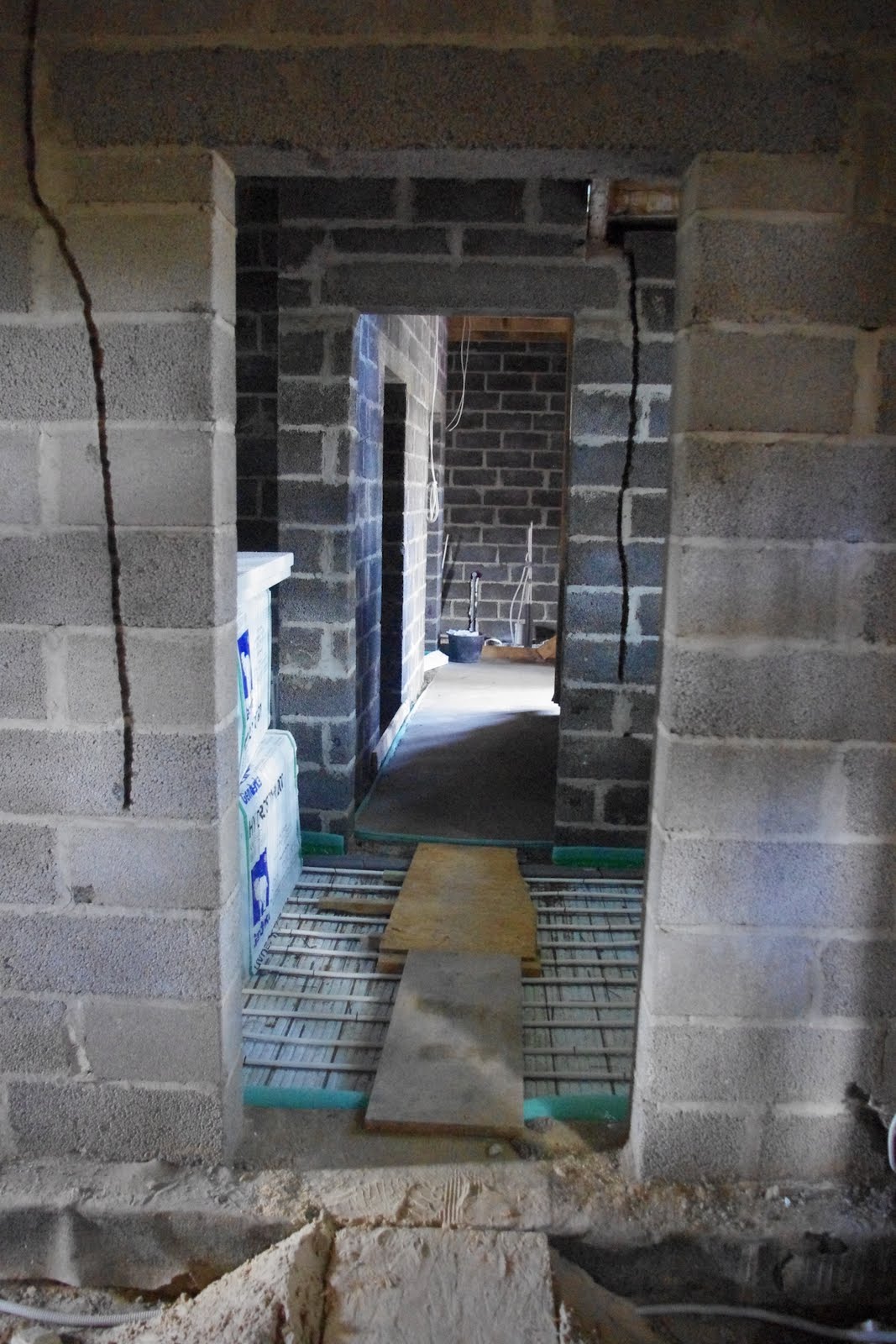
 Things are moving. Slowly, slowly, but surely. The builders keep telling me that if they can just get a few more boys on the job, we could be moving in by autumn... personally I think Christmas is a more likely scenario, but, whatever. Come 2011 I may be almost properly equipped to take on visitors from Australia!
At first these photos seemed very macho and technical, but I'm starting to get an appreciation for the Jeffrey Smart-esque lines and placement of certain items, and the colours. Jeremy's been photographing every time we go to the house, and we have a growing folder documenting the progress of the building work.




We had the usual hoard of people descend on the the property and spent a good few days beforehand preparing. The weather was truly amazing - clear and sunny, with that golden light of midsummer wrapping everything, and we sang and danced around our yard until it was time to walk through the field to climb our "Jāņi hill" and watch the sun set behind the trees. The view was spectacular, with the sun setting on one side of the hill and the moon rising on the other side.
The sunset is always the culmination of Jāņi - when you celebrate the longest day of the year, and symbolically say goodbye to the sun, as you start the slow descent downwards to winter and darkness again. Jāņi is also traditionally seen as the peak time of "nature's energy", if you like, the most intense time of flowering of nature, everything growing and green and full of life. Earlier Latvians also believed that Jāņi night was a dangerous one - that witches and fairies and wizards and envious, evil people walked the earth on that night, trying to do harm to your farm and its creatures. Because of this you had to stay awake all night, and await the sun rising again the next morning. Today we still sing songs to protect against witches at Jāņi, and put rowan branches and nettles and thistles into our Jāņi wreaths and decorations, as symbols of warding off the evil at work that night.
While we were all singing to the sunset, and rolling Jem's excellently built burning ball of hay down the hill (no cartwheel this year), tragedy struck in our yard. The stork's nest, which stands on some old concrete electricity pylons in the middle of the yard, collapsed from the weight of many years of nests built one on top of the other. The two baby storks that were being raised in the nest were not yet old enough to fly, and they hit the ground hard, along with years of heavy, built up sticks and moss and grass and mud. Mum and dad stork flew off in terror. One of the birds was badly injured, with bone and blood and limbs skewed, while the other was trying to stand.
All of the Kūgures inhabitants were in shock - the stork's nest is such a fixture in our house, and I dare say that in all of our minds the storks and their welfare is symbolic to us of the health and well being of the farm itself. Each year we live along with these birds - cheer them when they arrive home from their long trek to Africa, watch them with concern when we know they are hatching their baby storks, feel a sense of loss when we arrive at Kūgures in September, to realise the storks have left on their yearly migration. When Matīss took his first steps outdoors at Kūgures when he was not yet a year old, I watched the baby storks sitting on the edge of the nest, jumping and flapping and training their wings for flying. For the last two years the storks have not had any babies - and we have all been worried - and so this year we were overjoyed and relieved to see two healthy, fat baby storks being fed and looked over by their parents. Until Jāņi.
While our guests kept singing and merrymaking (they were on another hilltop and unaware of what had happened), Jeremy and a friend raced off to try to work out what to do. The injured stork needed to be put down, and the other stork seemed to be trying to stand. Jeremy bundled it into a box lined with hay and put it into our warm, quiet attic, hoping it wasn't too injured and that it may survive if left alone. When Matīss heard the news he began to wail and scream, and in my own shock I took him away down the hill and tried to explain, to console him in his hysteria. Apart from the fact that the nest collapsing seemed impossible, I was fighting my own sadness, and an irrational and overpowering sense of fear, because my mind immediately turned to the superstitions about witches and other bad creatures that roam at Jāņi.
The festivities continued on, of course, and we were calmed by our guests who reassured us about it being nature's way, and that they would come back next year, and this type of thing happened all the time, and there's nothing we could do, etc. I cursed myself for being a stupid city-slicker taking country problems to heart, and realized that any half-decent country dweller is used to this kind of devastation, sees it as normal, and doesn't spend much time or emotion worrying. The night went on as planned, and we saw in the sunrise in the most amazing blaze of colour - by far the most spectacular Jāņi sunset and sunrise I've ever witnessed. After a couple of hours sleep in the tent I got up, worried about the bird and what we'd do about it. Turned out there were a few people with similar thoughts, and by the end of breakfast we were coming up with plans and multiple options for what to do with a flightless baby stork.
One guest had rung a vet clinic and listened to their advice, who said that there was a chance that the mother would come back if we placed the baby in a new nest in the same place. While our friend Dace and I fed the stork with cut up and mashed worms (Dace, the legend, did the cutting), others started to weave a giant replacement bird's nest on the end of our barn roof. It seemed like such a long shot, but we had enough artists and musicians at our house to be fanciful enough to try it out! Jeremy and a team of blokes went to chop down willow branches, and passed them up to two guys on the roof (an architect and photographer!) who did the weaving. They took all morning doing it, while I was running around, anxiously feeding our Jāņi guests a neverending breakfast, and digging for worms in between, watching the baby stork in the attic, who seemed to be fading. When the nest was ready towards the afternoon, the baby stork's head was flopping down, and I had to hold it up and force its beak open for Dace to syringe in the worms. It seemed totally impossible that the mother bird would come back to a completely strange, manmade nest and adopt this ragged, half-dead baby.
Nevertheless we placed the baby in the nest, realizing that nature would have its way with the bird one way or another. Amazingly, as soon as people had climbed off the roof, we saw the baby bird pop its head up out of the nest and look around - the little bugger! Turns out it had been "playing dead" with me, and actually had the strength to lift its head all along. So we retreated from the nest and settled down to wait. Most of our guests left, and with hearts getting heavier every hour, we watched the nest as it sat abandoned in the wind and the sun. It looked like nothing was going to change, and I began making plans for Jem to get onto the roof and do a dusk feed for the bird, to at least keep it alive till morning. And then... the storks did a "fly by" low over the new nest. They peered inside... and flew away. In the evening, though, they were standing on the ground next to the shed, seemingly oblivious to the baby that desperately needed their help. They picked around there for about three hours, and by the time we were going to bed, they had both flown up to the shed roof, and were sitting there nonchalantly, not in the nest, but about a metre away. Pretending they didn't notice it.
We went to bed with quiet hope, but not getting too excited, but wishing that our crazy scheme may have worked. In the morning I woke to hear the patter of rain on the window, and went outside, blurry-eyed, to see what was happening - and mother stork was there in the nest, wet feathers puffed out, with baby stork sheltering from the rain by her legs! Truly a Jāņi miracle. We watched the rest of the morning as the storks came up to feed the baby, and carried up new twigs to correct and repair our man-made attempt at a nest.
On returning home we've had so many messages and calls from other Jāņi visitors who were worried for the stork - it turns out most of our city-slicker friends were as worried, and just as relieved as we were about the drama unfolding in our yard. An amazing outcome - against all hope - and it seems that there is light and goodness in the world after all!


The nest the day of the collapse - in hindsight, you can already see it listing to the side

What was left on the posts after the nest came down


Men at work. Seemed like an impossible task, but they didn't give up.

The baby before putting it into the nest

Success!


